

Lebanese wine has been made in the Bekaa Valley for thousands of years. It’s one of the quiet treasures of Lebanese cuisine. This guide introduces that heritage: where it comes from, what makes it distinctive, and how it finds its way into a bottle on your table.
Lebanon as a wine country
Lebanon’s relationship with wine is older than almost anywhere else on earth. The Phoenicians, who called this coastline home, are widely credited with spreading viticulture across the ancient Mediterranean. Wine wasn’t a Lebanese import. In many ways, it was a Lebanese export to the rest of the world. That heritage never really left.
Through decades of upheaval, Lebanese winemakers kept planting, harvesting, and ageing, often against considerable odds. What survived is a wine culture with real depth: family estates, indigenous grape varieties, and a winemaking identity shaped as much by resilience as by soil. Today Lebanon produces a modest amount of wine by global standards.
The Bekaa Valley
The Bekaa Valley is Lebanon’s wine country, and it’s a genuinely remarkable place to grow grapes. Sitting at around 1,000 metres above sea level between two mountain ranges, it has a climate that vintners elsewhere would envy:
- Hot, dry summers that ripen fruit fully
- Cool nights that preserve acidity and freshness
- Natural irrigation from snowmelt held in the valley’s own water table
- Minimal need for pesticides, so many vineyards are grown close to organic.
That altitude and temperature swing is the real secret. It gives Bekaa Valley wine a tension between richness and brightness that’s hard to find elsewhere.

Lebanese wine producers
A handful of estates have shaped what the world knows of Lebanese wine. Château Ksara is the country’s oldest winery, founded by Jesuit priests in 1857. While clearing land, they uncovered two kilometres of Roman tunnels, now used to age wine in near-perfect natural conditions.
Ksara remains Lebanon’s largest producer and a genuine benchmark for the region. Château Kefraya followed in the twentieth century, with its first vines planted in 1946 in the heart of the valley, among ancient rock formations once used as tombs. Kefraya has become known for ambitious blends and its flagship Comte de M.
IXSIR, a newer arrival founded in 2008, works high-altitude sites around Batroun and in the Bekaa itself, bringing a more contemporary style to Lebanese winemaking while staying rooted in local grapes.
Red, white, and rosé from Lebanon
Lebanese wine spans all three colours, each shaped by that Bekaa altitude. Reds tend to lean on Bordeaux varieties: Cabernet Sauvignon, Merlot, Cinsault, sometimes Syrah, often blended. Expect dark fruit, warm spice, and a structure built to age. Whites are where Lebanon quietly shines. Blends of Muscat, Sauvignon Blanc, and Viognier.
Rosé rounds things out with pale, fresh, fruit-driven styles, perfect for lighter mezze and warm evenings. What ties them together isn’t a single house style. It’s that Bekaa Valley tension between sun-ripened fruit and cool-night acidity, present across the whole range.
How to pair with mezze
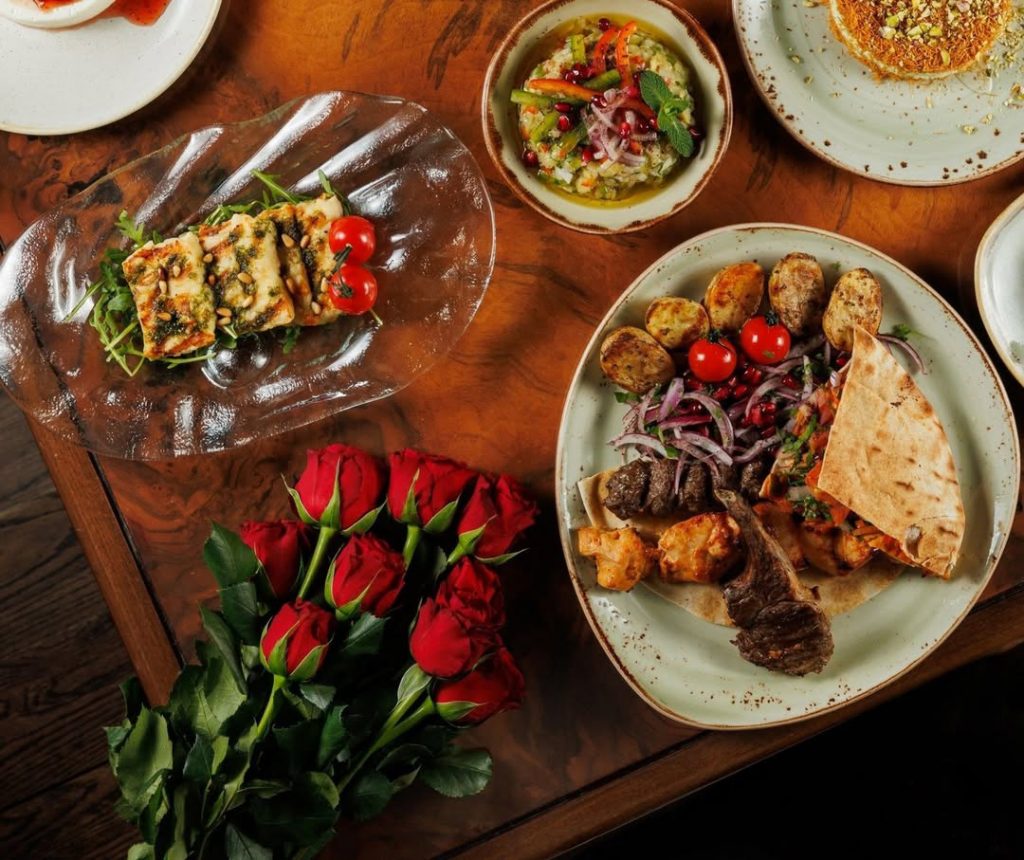
Lebanese wine and Lebanese food were made for each other, and mezze in particular gives you room to explore. A few simple pairings to try:
- Cold mezze like hommos, moutabal, and tabbouleh pair beautifully with a crisp Lebanese white; the citrus and herb notes echo the dish’s freshness.
- Grilled meats such as shish taouk or lamb chops call for a fuller-bodied red, something with enough structure to stand up to charcoal and spice.
- Shared platters with a mix of dishes are a good reason to order a bottle of rosé, versatile enough to move between courses.
Because mezze is designed for sharing, wine at a Lebanese table tends to work the same way. A bottle in the middle, poured for everyone, is as much a part of the hospitality as the food itself.
The wine list at Maroush
Lebanese wine has been part of the experience since the very beginning in our restaurants. Our wine list draws on some of the producers covered here, chosen to sit comfortably alongside the mezze and grills. It’s one thing to read about the Bekaa Valley. It’s another to taste it, ideally with a table full of mezze and good company.
Our Edgware Road flagship, with its live music and belly dancing most evenings, is a particularly memorable place to try a glass alongside dinner. You’ll also find a thoughtful wine list across all our London restaurants. Take a look at our menus, and when you’re ready, book a table. We’d love to pour you a glass.