

There is a moment, just before a plate of tabbouleh arrives at your table, when you catch it on the air: bright, clean, unmistakably alive. That’s lemon. And in Lebanese cooking with lemon, that brightness isn’t a finishing touch, it’s a foundational philosophy.
Lemon in the Lebanese kitchen
Ask what separates Lebanese food from the wider Middle Eastern table, and freshness is always the answer. That freshness comes, more than anything else, from lemon.
It works across every register. A squeeze lifts a dip out of heaviness. A generous pour through a marinade carries spice deep into the meat. A drizzle over grilled fish at the last moment brightens everything it touches without overpowering the char.
We have always sourced the best we can find in London, because the lemon you use is never a background detail.
Cold mezze: lemon’s starring role
Imagine the table at the start of a Maroush meal. Bowl after bowl, colour after colour: the ivory silk of hummus, the smoky cream of moutabal, the green vivid scatter of tabbouleh, the cool stretch of fattoush.
Lemon is present in every single one.
- Hummus: silky slow-cooked chickpeas blended with tahini, garlic, and a generous squeeze of lemon. The lemon cuts through the richness and turns something filling into something light and morish.
- Tabbouleh: flat-leaf parsley, tomato, spring onion, bulgur wheat, and lemon. Without it, tabbouleh becomes flat. With it, every bite is vivid and electric.
- Moutabal: the chargrilled aubergine, the tahini, and lemon to lift the smoke into something delicate rather than overwhelming.
- Fattoush: though pomegranate molasses and sumac bring their own tang, lemon underpins the dressing and keeps the whole salad dancing.
Grills and marinades
The charcoal grill is the heart of the Maroush kitchen. Every evening, our chefs tend to skewers of chicken shish, kofta, lamb cubes, and tender whole sea bass, all of them shaped by lemon long before they meet the heat.
Our chicken shish has been marinated in lemon, garlic, and herbs since the very beginning. It’s why the meat stays impossibly juicy on the outside of the char. It’s why guests who have been coming to us since the 1980s still order the same thing, still close their eyes on the first bite.
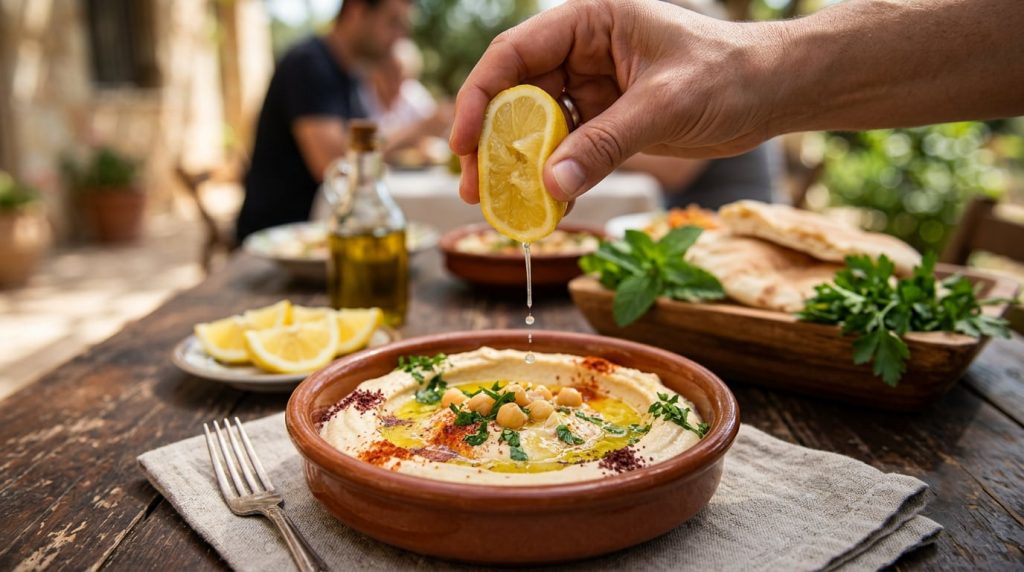
The lemon-tahini combination
If there is one pairing that appears more than any other across the Lebanese table, it is lemon and tahini. Together, they form the foundation of a sauce that accompanies grills, enriches dips, and dresses salads with an almost magical balance of nuttiness and brightness.
The ratio matters enormously. Too little lemon and the tahini is thick, heavy, clinging. Too much and the sauce turns sharp and thin. Exactly right and you have something that carries every dish it touches to a different level.
Lemon in desserts
Lemon’s role in Lebanese cooking doesn’t end with the savoury courses. Lebanese pastry uses citrus to balance the sweetness of honey and rosewater a thread of brightness that keeps even the richest desserts feeling light and refined.
Orange blossom often leads, but lemon sits beneath it, quietly preventing the sweetness from tipping into excess. Many guests tell us that Lebanese desserts feel cleaner on the palate than others they’ve tried; this is precisely why.
Freshness as a philosophy
In Lebanon, there is a word taaze, that means fresh. It is not merely a description of produce. It is a standard, an expectation, a way of life.
Lebanese cooking with lemon is really an expression of this philosophy. The acid in freshly squeezed juice is volatile; it begins to fade within hours. This is why, in a properly run Lebanese kitchen, lemon is squeezed to order or squeezed that morning, never from a bottle, never from concentrate.
Taste it at Maroush
Reading about lemon in Lebanese food is one thing. Tasting it is another.
There is a particular pleasure in sitting at a table in one of our London restaurants as the mezze begins to arrive, the cool of the hummus, the herby brightness of the tabbouleh, the first bite of chicken shish, still fragrant from the grill. You’ll understand, in that moment, exactly why Lebanese cooks have treated lemon as something close to sacred for centuries.
We’ll have the lemons ready.