

There are sauces, and then there is toum. At Maroush, this extraordinary white garlic sauce, silky, intensely garlicky, and impossibly light, has been arriving at our tables alongside the grills since Marouf Abouzaki first opened our doors on Edgware Road in 1981. Barely a week passes without a guest asking for the toum recipe Lebanese cooks have handed down for generations. So here, finally, is our answer.
What Is Toum?
Toum (تومة) is Lebanon’s defining condiment. The name comes from the Arabic word for garlic itself, ṯūm, and the sauce earns every letter. It is the thing that appears, without ceremony, alongside the grills in every Beirut neighbourhood restaurant, the dip that disappears from the table before the bread basket is even half empty, the sauce that turns a simple wrap into something genuinely memorable.
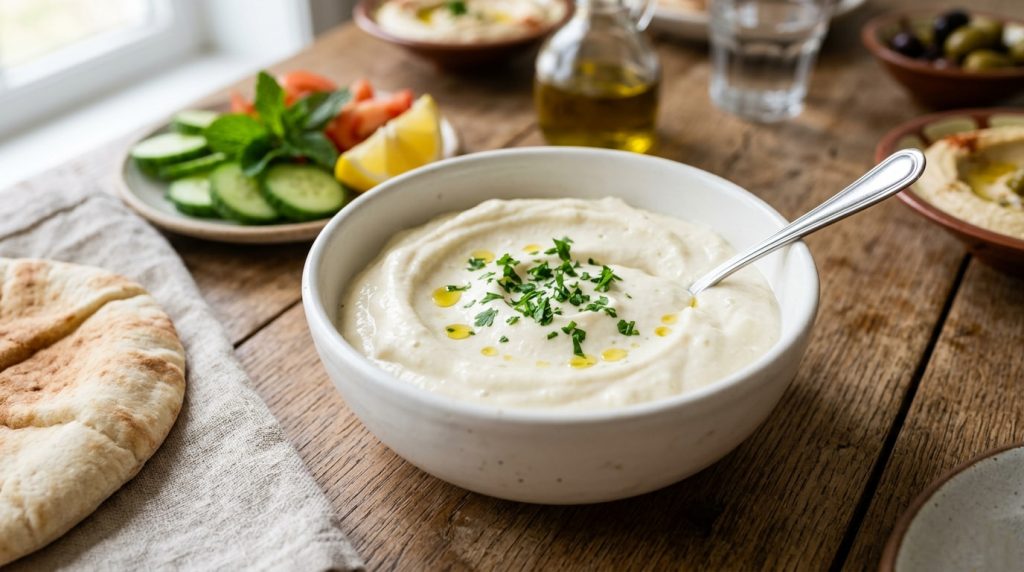
Ivory-white, astonishingly fluffy, fiercely garlicky, toum is nothing like anything else you will find on the table. And unlike aioli or mayonnaise, it contains no eggs and no dairy. Just four ingredients, and a technique that has been practised in Lebanese kitchens for centuries.
How It’s Made
The traditional preparation begins with raw garlic cloves, peeled and crushed or very finely minced to release everything they hold. A little salt is worked in to draw out moisture and begin breaking the garlic down. Then comes the critical part: a neutral oil is introduced in the slowest possible stream, while fresh lemon juice is added in alternating small pours.
Traditionally this was done in a wooden mortar, the pestle moving in a steady rhythm for as long as it took. Today, a food processor has replaced the mortar in most kitchens, including our own, but the principle has not changed. Patience, slowness, and a very steady hand.
Why It’s Not Just Garlic Mayo
This is the question we hear more than almost any other. The answer matters, because toum really is something different.
Mayonnaise relies on egg yolks to create its emulsion. The lecithin in the yolk is what binds oil and water together. Toum achieves the same result without eggs at all, using garlic proteins as the emulsifier. This means it is:
- Vegan and egg-free
- Noticeably lighter
- Much more intensely garlicky
- Halal and dairy-free
It is also distinctly Lebanese in character. The lemon gives it brightness. The raw garlic gives it heat. The whipped texture gives it a generosity that heavier, creamier sauces simply cannot match. This is a Lebanese garlic sauce built for sharing, and at Maroush, everything is.
The Emulsification Technique
Want to know how to make toum at home? The single rule that matters most is this: never rush the oil.
- Crush a full head of garlic with a generous pinch of salt
- Blend briefly in a food processor to form a smooth, fine paste
- With the processor running continuously, add a neutral oil, sunflower or canola work best; olive oil turns bitter, in the very slowest possible stream
- Alternate with small pours of fresh lemon juice every 30 seconds or so
- Keep going until the mixture thickens, whitens, and holds its shape
The whole process takes 8 to 10 minutes. Rush it, and the emulsion will split into an oily puddle. Keep the pace slow and steady, and you will have something that feels, there is genuinely no other word for it, joyful.
How to Use Toum
Part of toum’s particular charm is how generously it gives itself to everything around it. At Maroush, our guests reach for it with:
- Grilled chicken: shish taouk, kafta, rotisserie, the pairing it was born for
- Warm Lebanese bread: scooped up as a dip the moment the basket arrives
- Grilled vegetables: it makes aubergine and courgette feel genuinely celebratory
- Shawarma: spread inside the wrap alongside pickles and fresh tomato
- Chips and roasted potatoes: a combination that requires absolutely no justification
If you make a batch at home, it keeps beautifully in a sealed jar in the fridge for up to two weeks. Though in our experience, it rarely lasts that long.
Toum at Maroush
We make our Lebanese garlic sauce fresh every single day. It is not an afterthought or a secondary condiment; it is woven into the identity of what we cook and who we are.
If you would like to taste it as it was always meant to be tasted with warm bread in your hand, a plate of perfectly chargrilled meat on its way to the table, and the warm noise of a full Lebanese restaurant around you, we would love to welcome you. Browse our London restaurants to find your nearest Maroush, and take a look at our menu to start planning your visit.