

There is a phrase in Arabic that does not translate cleanly into English, not because the words are difficult, but because the feeling behind them runs so deep. Ahlan wa sahlan. You are welcome here. You belong here. And in Lebanon, that is not just something you say at the door; it is something you live, something you cook, something you pour generously into every glass and plate you set before a guest.
At Maroush, Lebanese dining culture has always been at the heart of everything we do. Since our founder, Marouf Abouzaki, first opened the doors on Edgware Road in 1981, this is the spirit we have carried with us, not as a strategy, but as a way of life.
Hospitality as a Way of Life in Lebanon
Ask anyone who has visited Lebanon and they will tell you the same thing: the generosity catches you off guard.
It is not about extravagance for its own sake. In Lebanon, hospitality is quietly profound. A neighbour arrives and coffee appears before they have sat down. A guest mentions they are hungry and the kitchen becomes a symphony of chopping, stirring, and warmth. No one is fed minimally. No one is made to feel like a transaction.
This tradition stretches back centuries across the Levant rooted in Bedouin culture, sharpened by trade routes, and deepened by a people who understand that how you treat a guest says everything about who you are. It is woven into the Lebanese identity as tightly as the cedar tree on the flag.
The Tradition of Sharing Food in Lebanon
Lebanese dining etiquette is built around one beautiful principle: food is for sharing.
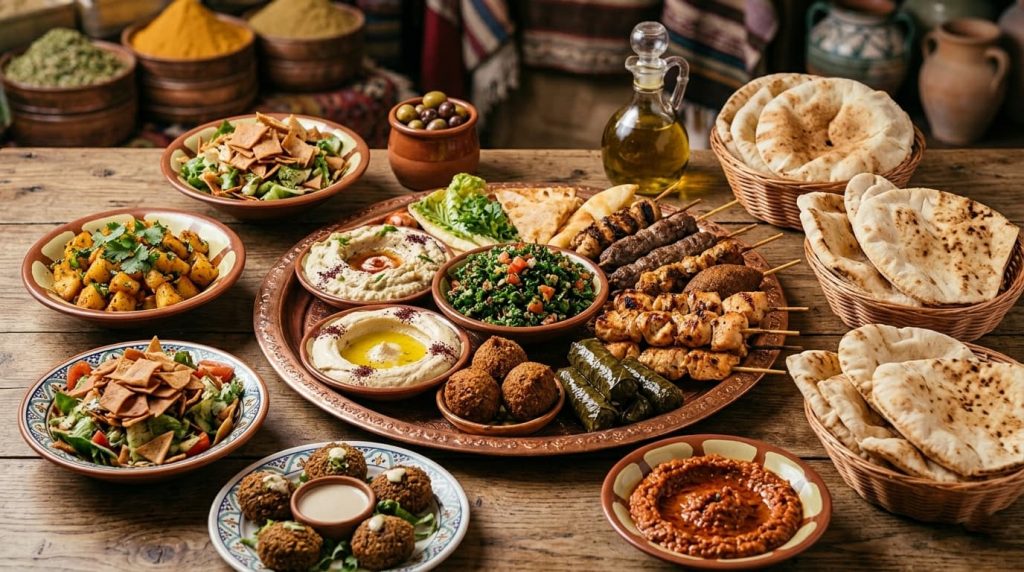
There is no such thing, really, as a solo mezze. The whole point of hummus, moutabal, fattoush, and kibbeh arriving on a table is that they arrive together, a landscape of small plates, each one inviting a hand from across the table. In Levantine food culture, the act of reaching for the same dish is an act of trust and closeness. It says: we are in this together.
This is why you will often find that a Lebanese meal begins long before the main course and ends long after dessert. The mezze is not a starter, it is an opening conversation. Warm bread tears open the dialogue. Plates multiply. Voices rise. Someone orders more tabbouleh. Someone else insists on the batata harra.
This instinct to linger, to share, to pour another glass of arak and stay a little longer is not accidental. It is baked into the very structure of how Lebanese people eat. Sharing food in Lebanon is not a dining style. It is a social language.
What Ahlan wa Sahlan Really Means
Ahlan wa sahlan is one of the most commonly heard phrases in the Arabic-speaking world, and also one of the most misunderstood.
Broken down, it tells a guest: you are among family (ahlan), and you have arrived on easy ground (sahlan), meaning there are no obstacles here, no formalities, no distance between us. Come as you are.
In Arabic dining etiquette, this spirit runs through every gesture. The host who insists you take the last piece. The waiter who remembers your name. The table that somehow always has room for one more chair.
It is the opposite of transactional. It is warm, personal, and when you experience it, genuinely moving.
We think about ahlan wa sahlan often at Maroush. Not as a phrase printed on the wall, but as a quiet commitment we make every time a guest walks through our door.
How Maroush Brings This to London
When Marouf Abouzaki opened the first Maroush on Edgware Road more than four decades ago, he was not simply opening a restaurant. He was transplanting a culture.
The dishes were authentic prepared from recipes carried from Beirut, using ingredients sourced with the same care that Lebanese home cooks have always brought to their kitchens. The bread was baked fresh. The mezze was made daily. The grills were lit and smoky and real.
But the thing that truly made Maroush different, the thing that kept guests returning for years, then decades, was the feeling. The generosity of a table that always offered more than you expected. The music at the Edgware Road flagship, the live entertainment, the sense that you had not just eaten dinner but had been part of something.
Guests who first visited us in the 1980s still come today. They bring their children. Their children bring their friends. That is not loyalty built by a loyalty card, it is loyalty built by a culture of genuine care.
Across our London restaurants, from Kensington to Beauchamp Place, from King’s Road to Park Royal, that same spirit travels. It sits in the quality of the ingredients. It is in every plate of mezze that arrives at your table, generous, vivid, and made with pride..
Come and Feel It Yourself
You can read about Lebanese hospitality. You can understand it, intellectually, as a cultural tradition, ancient, meaningful, beautiful.
But you cannot truly know it until you are sitting at a table, reaching across for the hummus, listening to the chatter around you, breathing in the smell of charcoal-grilled meat and warm flatbread fresh from the oven.
That is what we want for every guest who comes to Maroush. Not just a good meal, but the feeling of ahlan wa sahlan, the feeling that you are exactly where you should be, among people who are glad you came.